
Most weeds in a South Florida lawn are a nuisance you can solve in a weekend. Pull the spurge, spot-spray the pusley, mow a little higher, move on.
Then there are the other ones. The weeds that come back three weeks after you sprayed them, where every product at the big-box store either doesn’t touch them or burns your grass worse than the weed did.
This is a guide to those weeds — eight of the hardest to kill in Palm Beach County, why each resists control, and what genuinely works. Products are named alongside the active ingredient doing the work, so you can recognize the same chemistry under a different label.
Why South Florida is a harder place to kill weeds
There’s no winter. Weeds in Georgia get knocked back by frost every year, which resets the population. Here, summer weeds keep growing and winter annuals fill whatever gaps open up. Weed pressure is a twelve-month problem, not a spring problem.
The turf is sensitive. St. Augustine, particularly Floratam, tolerates a much narrower range of herbicides than Bermuda or zoysia, so whole chemical families that work elsewhere are off the table. Quinclorac — the standard crabgrass rescue in most of the country — isn’t labeled for St. Augustine, and people damage lawns with it every year. Confirm your grass before you confirm your product.
And it’s hot. Most postemergence herbicides carry temperature limits, usually between 85°F and 90°F, above which the product injures turf along with the weed. That removes a lot of days from a South Florida calendar, which is why spot-treating beats blanket-spraying from June through September.
Doveweed

Doveweed is the weed most people misidentify as grass: thick, succulent, lance-shaped leaves with parallel veins, forming mats in the wettest, lowest sections of the lawn.
What makes it tough is timing. It doesn’t germinate until soil temperatures hold at 65°F to 70°F — well after most homeowners put down a spring preemergent, so the barrier has degraded by the time doveweed arrives. It also spreads by stolons that root at every node, which means your mower is helping it move.
Control: Preemergence is the leverage point, but it has to be timed to doveweed rather than crabgrass — a late-spring application, not just the February one. Simazine applied before emergence gives good control and is safe on St. Augustine (it’s also the option that won’t hurt Bermuda, unlike atrazine).
Postemergence, the best option is Celsius WG (thiencarbazone-methyl, iodosulfuron and dicamba) at its high rate. It’s labeled for St. Augustine including Floratam, Palmetto and Bitter Blue, and unlike most broadleaf products its label sets no cutoff temperature for application, which is exactly why it’s worth the price in July. Above 90°F, skip the spray adjuvant and expect some temporary growth regulation on St. Augustine, but the product stays usable. Blindside (sulfentrazone plus metsulfuron-methyl) also lists doveweed and is St. Augustine-labeled. Expect two to three weeks before symptoms appear, and expect to fight doveweed for two or three seasons, because the seed bank outlasts any single year of spraying.
Torpedograss

This is the weed with no good answer, and it’s better to know that before you spend $200 finding out.
Torpedograss has silver-green blades, a prominent midrib, sharply pointed tips, and a stiff upright habit that never quite matches the lawn around it. It spreads by aggressive rhizomes — the “torpedoes” — that drive deep into sandy soil and re-sprout from any fragment left behind.
Control: In Bermuda and zoysia, quinclorac and trifloxysulfuron can be used at labeled rates. In St. Augustine and bahia, UF/IFAS is blunt: no herbicide controls torpedograss without severely damaging the turfgrass.
The realistic path is to kill infested patches with glyphosate or fluazifop, wait, treat the regrowth, then re-sod. That only works if you’re honest about the boundaries — rhizomes extend well past the visible patch, so the kill zone needs to be larger than the weed looks. If torpedograss has taken more than a third of the lawn, full removal and re-sodding is cheaper than three seasons of partial fixes, and proper vegetation removal and soil prep is what keeps it from coming straight back through the new sod. Prevention matters more here than anywhere else on this list: clean equipment, weed-free fill, and sod from a source you trust.
Purple nutsedge and green kyllinga

Sedges aren’t grasses. They grow faster than the turf, stand above it within days of mowing, and have triangular stems you can feel by rolling one between your fingers.
Purple nutsedge is the harder of the two. It produces tubers in chains along its rhizomes — potentially millions per acre in a season — sitting four to eight inches deep. It rarely produces seed in the U.S.; it’s a purely underground problem. That’s why pulling never works: the shoot snaps off and the tuber chain stays. Because those tubers don’t all break dormancy at once, no single application finishes the job, and they can stay viable for one to three years.

Green kyllinga is different. No tubers, but it forms dense low mats that tolerate mowing at any height, spreads by rhizomes, reseeds itself, and thrives in the same soggy ground.
Control: Halosulfuron is the workhorse. SedgeHammer+ is the homeowner version with surfactant already in the pouch — one 0.5 oz packet per gallon covers 1,000 square feet. It’s St. Augustine-labeled, works best at the three- to eight-leaf stage, and allows a second treatment six to ten weeks later. Don’t mow within two days on either side, and expect several weeks for full effect. Excellent on purple nutsedge; on green kyllinga, treat it as suppression and plan on sequential applications.
For speed, sulfentrazone (Dismiss) is the fastest of the group — the manufacturer cites visible activity in 24 to 48 hours — though it can cause temporary discoloration on St. Augustine. One critical distinction: Dismiss and Dismiss South are not the same product. Dismiss South contains imazethapyr and is labeled for warm-season turf excluding St. Augustine. Retailer listings blur these constantly — read the front of the jug.
Whatever you choose, fix the water first. Sedges are telling you the soil stays wet, and chronic drainage problems will refill the population faster than any herbicide empties it.
Virginia buttonweed

A sprawling perennial with opposite dark green leaves joined by a membrane at the stem and small white four-petaled flowers.
Buttonweed is hard to kill for three reasons stacked together. Deep, fleshy roots that regenerate from fragments. Spread by stem pieces, which means every pass with a mower or string trimmer plants more of it. And flowers produced underground as well as above, so it sets seed even when you never let it bloom. It tolerates mowing as low as half an inch, so you can’t cut it out of existence either.
Control: University of Georgia trial data puts Celsius WG at 80 to 100 percent control from single applications — the best performer on St. Augustine. Blindside also lists buttonweed. Metsulfuron alone is noticeably weaker, in the 70 to 79 percent range even with repeats.
Two cautions matter here. Products containing metsulfuron, dicamba or atrazine are absorbed through the roots of ornamentals — don’t spray them under the driplines of trees and shrubs. In a typical Palm Beach County yard, the palms, oaks and bed edges are sitting inside the turf you’re about to treat. And the homeowner 2,4-D-based products that also list buttonweed can injure St. Augustine in hot, humid weather above 90°F, which is another argument for spot-treating patches in August rather than blanket-spraying.
Plan on repeated applications. LSU says it often takes four applications of herbicide to keep buttonweed in check, and Clemson notes that two years of postemergence work isn’t unusual. Bag the clippings while you’re fighting it.
Dollarweed
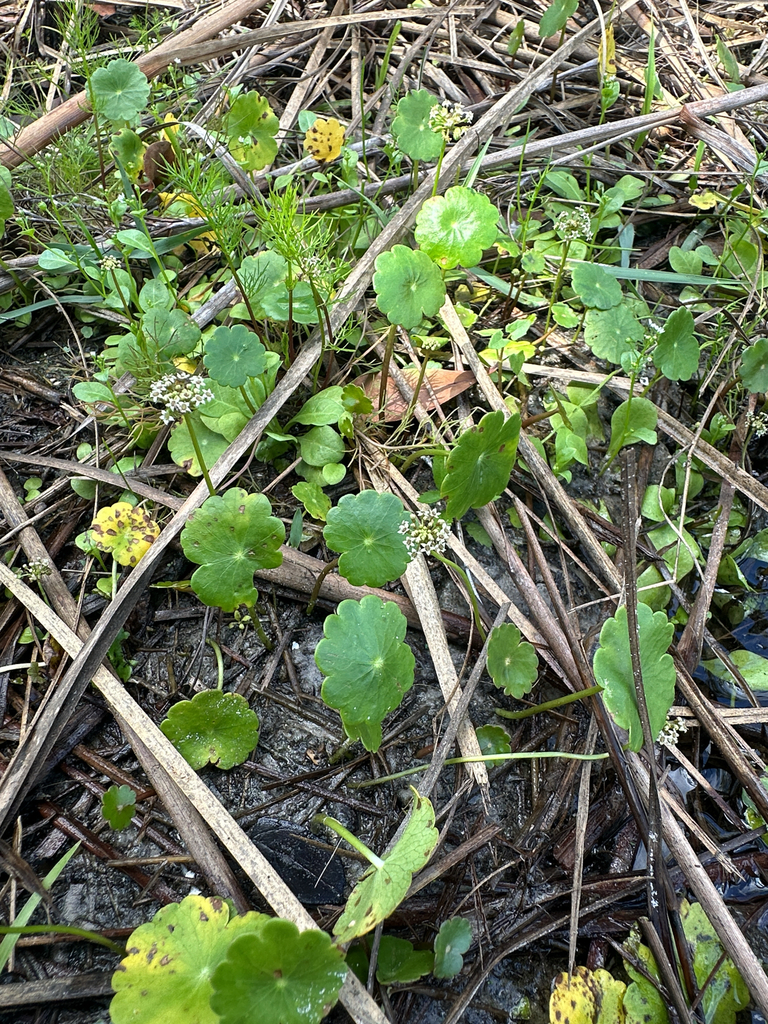
Bright green, round, glossy leaves with a scalloped edge and the stem attached at the center, like a tiny lily pad. It’s the most common “what is this” call in South Florida, and the one weed here where the herbicide is the second-most-important part of the answer.
Dollarweed is a symptom of soil that stays too wet, and research shows populations drop from reducing irrigation frequency alone. Check for a leaking valve, a head watering the same spot twice, or low areas where water sits after a storm. Deep, infrequent watering does more over a season than most spray programs, and compaction compounds it, which is where aeration earns its keep.
Control: Atrazine works well and is limited to two applications a year on St. Augustine. Homeowner atrazine labels prohibit application above 90°F, and UF/IFAS notes injury can start showing up above 85°F, so treat it as a fall and late-spring tool rather than a July one. Imazaquin also handles dollarweed slowly, with a second application possible around six weeks out. Celsius lists it, and Blindside covers it too.
Broadleaf combination products containing 2,4-D and dicamba will work, but St. Augustine is genuinely sensitive to 2,4-D. Use only products specifically labeled for it, at the St. Augustine rate, under the label’s temperature limit — Image Southern Lawn Weed Killer, for example, warns against application to St. Augustine above 85°F unless you can tolerate turf injury. And never apply a broadleaf product during spring green-up.
Chamberbitter

Sometimes called “little mimosa” because the leaflets look like a mimosa seedling. The giveaway is on the underside of each branchlet: a row of small green warty seed capsules.
Chamberbitter germinates once soil warms to roughly 70°F to 75°F, later than the weeds your spring preemergent targeted. It’s a prolific seed producer, and the mature fruits shatter explosively, throwing seed across the lawn. Once the plant develops a woody base, herbicides struggle with it.
Hand-pulling works in one narrow sense — no rhizomes or tubers, so the plant won’t regrow — but check the undersides first. If the capsules are there, pull it low, don’t shake soil off the roots, and drop it straight into a bucket rather than carrying it across the yard.
Control: Preemergence options include atrazine, isoxaben (two applications about eight weeks apart), prodiamine, dithiopyr and simazine. Timing is everything, and in South Florida that means going down earlier than the Panhandle guidance you’ll find online, because our soil warms sooner. Prodiamine’s residual is rate-driven, so a low-rate February application won’t still be working when chamberbitter shows up.
Postemergence, atrazine is the standard recommendation on St. Augustine and centipede: two treatments about 30 days apart after full green-up, spot-treated rather than broadcast once summer heat arrives. Celsius also lists chamberbitter. Blindside does not, whatever a product listing may claim.
Goosegrass

Goosegrass forms a flat rosette with a distinctive whitish, silvery center, and the seedheads look like a zipper. It’s the grassy weed people mistake for crabgrass, and treating it like crabgrass is why it wins.
It germinates around 60°F to 65°F, roughly two weeks later than crabgrass, so a crabgrass-timed preemergent is already fading when it arrives. UF/IFAS notes that in Florida germination can occur essentially year-round, meaning mature plants are often present before the season even starts, and herbicide-resistant populations have been confirmed in the state. Goosegrass is also a compaction indicator — a heavy infestation is usually telling you about traffic and soil density, not about your spray program.
Control: Oxadiazon is the industry standard for preemergence goosegrass control, but Ronstar isn’t labeled for residential lawns at all, which takes the best option off the table for homeowners. Indaziflam (Specticle FLO) is labeled for residential lawns and performs well, though it’s capped at a lower rate on St. Augustine than on Bermuda or zoysia. Prodiamine will work at the upper rate band with a split application, the second treatment 60 to 90 days later — with the caveat that Florida populations resistant to prodiamine have been documented, so if a full-rate program isn’t working, resistance is a real possibility rather than an excuse.
Timing here is roughly March 1, three to four weeks after the standard February preemergent date, or when soil temperatures hit 60°F for 24 consecutive hours.
Postemergence, homeowner options in St. Augustine are thin. Sulfentrazone has some activity but drops off sharply once goosegrass tillers, and Celsius doesn’t list goosegrass at all. MSMA, the old standby people still recommend in forums, has been illegal for residential lawns since 2009.
The one genuinely effective selective treatment is the same tank mix that solves Bermuda in St. Augustine — Recognition plus Fusilade II — which the label covers for goosegrass as well as Bermuda. Details are in the Bermuda section below, including the reason you shouldn’t reach for it if crabgrass is your actual problem. Short of that, catch goosegrass as a seedling and use aeration to fix the compaction that invited it.
Crabgrass in St. Augustine follows the same catch-it-early rule: Celsius works at early growth stages, atrazine only helps on young seedlings, and quinclorac — the product that solves crabgrass everywhere else — isn’t labeled for St. Augustine and will damage it.
Common Bermudagrass in a St. Augustine lawn
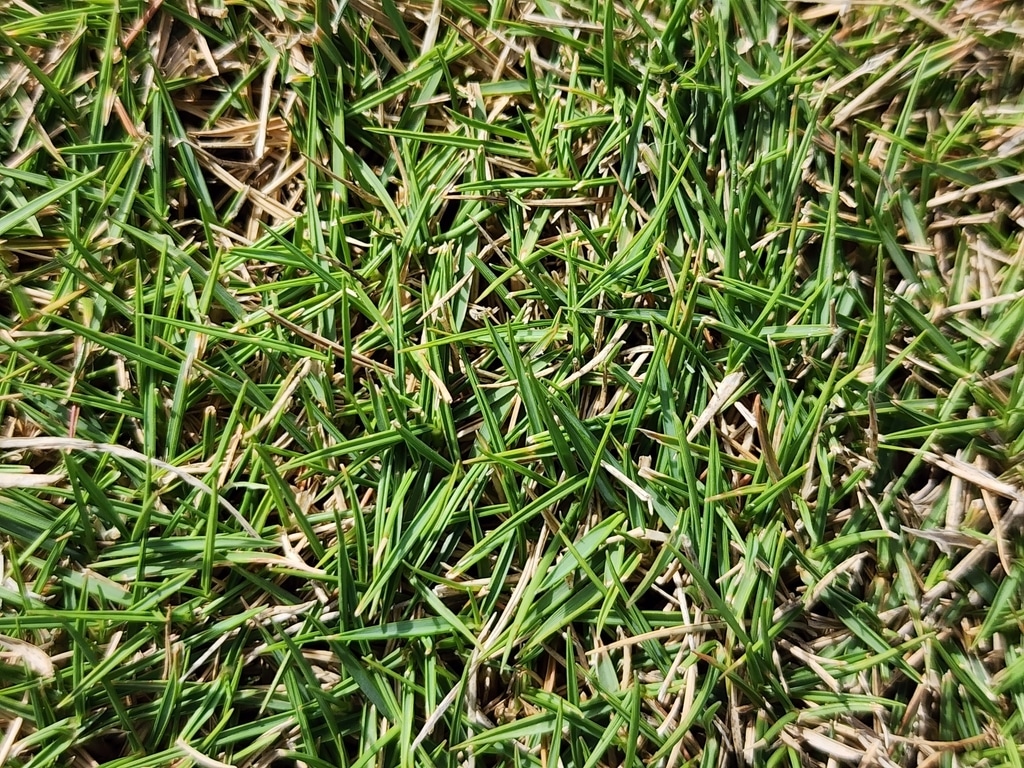
The last one isn’t a weed at all. It’s a lawn grass in the wrong lawn, and it’s the most frustrating problem we get called about. Bermuda invades from a neighbor’s yard, a swale, or a contaminated pallet of sod. It’s finer-textured, spreads by both stolons and rhizomes, and outgrows St. Augustine in full sun, so it slowly takes the sunniest sections.
For years the honest answer here was “you can’t.” That changed. There is now a labeled selective program, and it works.
Control: Recognition (trifloxysulfuron-sodium) tank-mixed with Fusilade II (fluazifop-P-butyl) controls Bermuda in St. Augustine without taking the St. Augustine with it. Fusilade alone would kill both — the trick is the metcamifen safener built into Recognition, which protects the St. Augustine while leaving the fluazifop free to work on the Bermuda. Recognition on its own doesn’t control Bermuda at all; it’s the combination that does the job. The tank mix is on the label for residential lawns, so this isn’t a golf-course-only workaround.
On St. Augustine, the label rate is Recognition at 1.95 oz per acre (0.045 oz per 1,000 sq ft) with Fusilade II at 12 to 24 oz per acre (0.28 to 0.55 oz per 1,000 sq ft), plus a non-ionic surfactant at 0.25 to 0.5 percent by volume. Repeat when the Bermuda starts regrowing — roughly four weeks at the lower Fusilade rate, five to six weeks at the full 24 oz — with a 28-day minimum between applications and no more than 6.26 oz of Recognition per acre in a year. Heavier infestations take several rounds, so treat it as a season-long program rather than a single spray.
Four things to get right. Recognition is proven safe on Floratam, Raleigh, Palmetto and SunClipse, but ProVista and Captiva may be more sensitive to injury. Don’t use this tank mix on crabgrass — the two actives antagonize each other and you’ll get poor control. Don’t let it reach Bermuda or kikuyu you actually want. And fertilize and water the St. Augustine through the program, because the whole point is having it spread into the ground the Bermuda gives up.
If the Bermuda has already taken most of the lawn, renovation is still faster than chemistry. UF/IFAS recommends more than one glyphosate application, with a second about 14 to 21 days after the first, and specifically notes a third is advisable when Bermuda is the target. Then remove the dead material for good soil contact before new sod goes down. If you’d rather avoid glyphosate, there are other renovation chemistries worth weighing, and running a proper fallow period separates a renovation that holds from one reinfested by the following summer.
The realistic product shelf
For most South Florida homeowners with St. Augustine, a handful of products cover the majority of hard cases.
Homeowner-available: an atrazine product labeled for St. Augustine and centipede (Spectracide Weed Stop for St. Augustine, Southern Ag Atrazine, Hi-Yield Atrazine) for dollarweed, chamberbitter and young grassy weeds — two applications a year, and not above 90°F. SedgeHammer+ for nutsedge, or Image Kills Nutsedge as a slower, cheaper option.
Professional-grade but available online: Celsius WG, the single most useful product on this list for a South Florida lawn — St. Augustine-safe, no cutoff temperature for application, effective on doveweed, buttonweed, dollarweed and chamberbitter. Blindside for buttonweed, doveweed and kyllinga. Dismiss (not Dismiss South) for fast sedge knockdown. And Recognition paired with Fusilade II if Bermuda or goosegrass is the problem — the two are sold as a kit, and it’s the only combination that removes either one from a St. Augustine lawn selectively. There’s more on matching postemergence products to specific weeds in St. Augustine if you want the full comparison.
What isn’t on the list: weed-and-feed. Combination products force you to fertilize on the herbicide’s schedule, and that timing almost never matches what the lawn actually needs. Some Palm Beach County municipalities also restrict nitrogen and phosphorus seasonally while the county itself uses weather triggers, so the rules differ from town to town — a weed-and-feed can be a prohibited application in one city and legal a mile away. And whatever you spray, keep pets off until the area is fully dry, since re-entry timing varies by product.
The part that matters more than the chemistry
Every weed on this list exploits the same opening: thin turf. Dense St. Augustine shades the soil surface, and most of these species need light at ground level to establish. The most reliable weed control program in South Florida is a lawn thick enough that seeds never germinate.
That means mowing at the right height for your grass — standard St. Augustine belongs at 3.5 to 4 inches, and cutting it short is the fastest way to invite everything above. It means watering deeply and infrequently instead of a light daily cycle that keeps the surface wet for sedges and dollarweed. And it means fixing thinning areas before weeds fill them, and knowing which weed you’re actually looking at before you buy anything.
It also means using preemergents on a calendar. In South Florida that’s around February 1 for summer annuals, or before daytime temperatures hold at 65°F to 70°F for four or five consecutive days, with a follow-up six to nine weeks later as the barrier degrades. For winter annuals, the fall application goes down when nighttime temperatures drop to 55°F to 60°F for several consecutive days — late October to early November here.
If you’re replacing a lawn that’s already lost the fight, picking a cultivar suited to your light and water conditions buys years of easier weed control — a shade-tolerant St. Augustine like CitraBlue holds density in a yard where Floratam thins and lets weeds in.
There’s also a point where DIY stops making financial sense — torpedograss or Bermuda across a meaningful share of the lawn, purple nutsedge that’s been there for years, or two seasons and several hundred dollars already spent on products that half-worked. That’s usually where a professional treatment program or clean sod on properly prepped soil costs less than continuing. If you’d rather handle it yourself, the guidance above is the same we’d follow: identify the weed correctly, match the product to the grass, respect the temperature limits, and fix the water.