
If your St. Augustine has yellow, thinning patches that shrug off fertilizer, look at the roots before you buy another bag of anything. There’s a good chance you’re dealing with take-all root rot, better known as TARR.
This is the time of year it shows up. UF/IFAS says TARR appears during Florida’s summer and early fall rainy season, and the worse news is timing: by the time the leaves turn yellow, the fungus has been working on the roots for at least two to three weeks.
Here’s how to tell TARR from the other usual suspects, which grasses handle it best, and what actually keeps it in check.
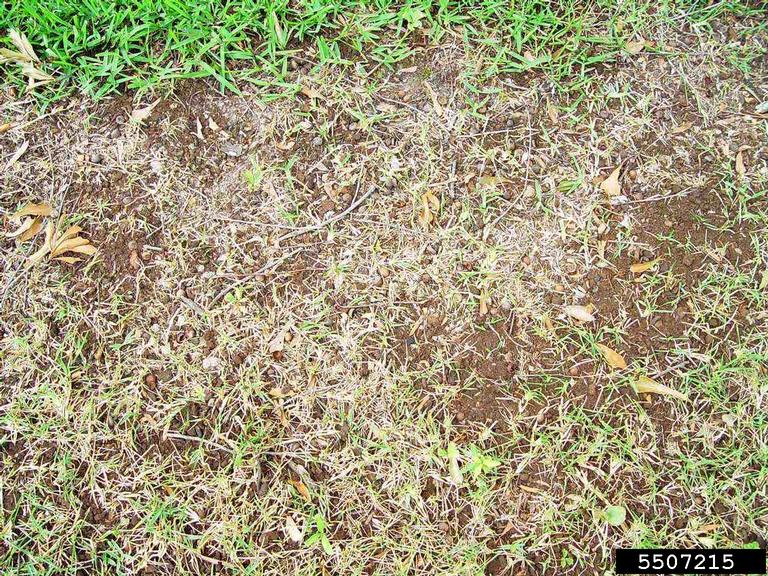
What Is Take-All Root Rot?
TARR is a root disease caused by the soil fungus Gaeumannomyces graminis var. graminis. It lives on the roots of nearly every warm-season lawn in Florida, healthy or not. UF/IFAS lists it on all warm-season turfgrasses and notes its older name, “bermudagrass decline.”
The fungus usually sits quietly. It turns destructive when two things line up: lots of rain and a stressed lawn. Short mowing, soggy soil, too much nitrogen, herbicide stress, thatch, and compaction all tip the balance.
Two things make TARR different from most lawn fungus:
- It attacks roots, not leaves. The yellow blades are a symptom of a root system that can no longer pull up water and nutrients.
- You can’t eliminate it. As a native soil-inhabiting fungus, it stays in the soil. The goal is to keep it from getting the upper hand.
One caution if you’ve been reading Texas lawn forums: out there, TARR is mostly a spring problem. In Florida, it peaks in our wet summer and early fall, so advice timed to a Dallas spring won’t line up with a Palm Beach County lawn.
How to Identify Take-All Root Rot
The fastest diagnosis is a pull test. Grab a handful of runners at the edge of a yellow patch and tug gently.
What you’ll see above ground:
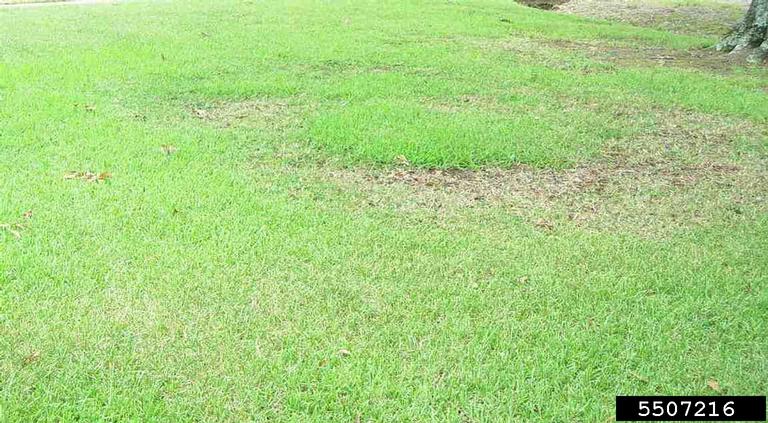
- Irregular yellow or light-green patches, from a few inches to a few feet across, per UF/IFAS
- Patches that thin out over weeks, then go bare and fill with weeds
- Yellowing that doesn’t respond to fertilizer or iron
What you’ll see when you pull:
- Runners lift out with almost no resistance, because the roots are gone
- Roots that are short, black, and brittle instead of white and fibrous
- Dark lesions on the stolons (runners) themselves

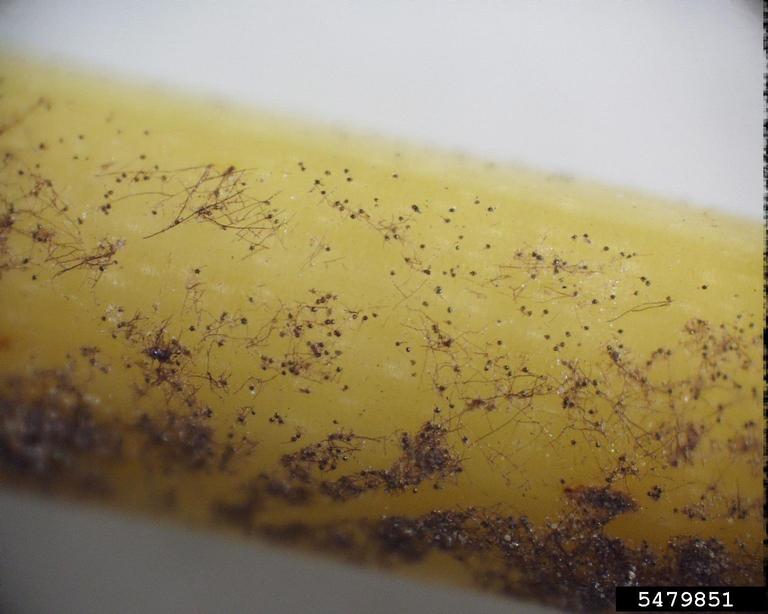
With a good hand lens, you may see dark threads of fungus and tiny lobed structures on the underside of infected runners. Alabama Extension calls those structures the feature that definitively identifies the fungus.
Want certainty? Your county UF/IFAS Extension office can help you send a turf sample to a university plant diagnostic lab. In-state samples to the UF Plant Diagnostic Center run about $40, which is cheaper than a season of the wrong fungicide. Dig a 4-by-4-inch square from the border of the patch, roots included.
Here’s what TARR looks like in a real homeowner’s yard, shared on Reddit:
St. Augustine Take All Root Rot
in r/lawncare
TARR vs. the Look-Alikes
TARR gets misdiagnosed constantly. A Hernando County extension agent warns that blaming every dead spot on chinch bugs leads to the wrong treatment and more damage. Here’s how to sort it out:
| Problem | When and where | What the pull test shows |
|---|---|---|
| Take-all root rot | Wet summer and early fall; sun or shade; irregular patches | Runners lift easily; roots short, black, brittle |
| Chinch bugs | Hot, dry spells; sunny spots near driveways and sidewalks | Roots intact; bugs float up in a can-and-water test |
| Large patch | Cooler, humid months; roughly circular rings | Roots fine; leaf sheaths rot and blades slip off the runner |
| Gray leaf spot | Summer rainy season, new growth | Roots fine; gray spots with dark borders on the blades |
| Drought stress | Dry weeks, high spots, poor sprinkler coverage | Roots fine; blades fold and perk up after watering |
If the patch could be more than one of these, our South Florida lawn fungus identification guide walks through each in detail. For lawns that are thinning without an obvious pattern, see why St. Augustine thins out.
Take-all Root Rot or just neglect?
in r/lawncare
Which Grasses Resist TARR, and Which Don’t
No warm-season grass is immune. Alabama Extension’s position is that St. Augustine cultivars show no real resistance. Newer Florida trials do show meaningful differences in how well each cultivar holds up, so the grass you choose still matters.
| Grass | Relative TARR risk | What the research says |
|---|---|---|
| CitraBlue St. Augustine | Lowest of the St. Augustines | UF says it isn’t hit as hard by disease as Floratam, Palmetto, or Raleigh. In UF disease trials it outperformed Floratam and Palmetto under TARR-favorable conditions. |
| Floratam St. Augustine | Moderate | Florida’s most common lawn grass. UF notes it is susceptible to gray leaf spot and other diseases; it trailed CitraBlue in UF’s TARR testing. |
| ProVista St. Augustine | Likely similar to Floratam | Built on Floratam genetics. We haven’t found published TARR data for it yet. |
| Palmetto St. Augustine | Higher | UF says it sometimes has disease problems in Florida’s humidity, and it trailed CitraBlue in TARR trials. |
| Dwarf St. Augustines (e.g., Seville) | Higher, by management | Mowed at 2–2.5 inches and prone to thatch, both TARR stressors. |
| Zoysia | Moderate | Listed as a TARR host by Arkansas and Georgia extension. |
| Bermuda | Higher when mowed low | TARR was first described as “bermudagrass decline.” UF’s photos show severe disease in bermuda cut too low. |
| Centipede | Lowest reported | Alabama Extension notes few TARR cases, but centipede is a poor fit for South Florida’s alkaline soils. |
Our read: if you’re replacing a lawn lost to TARR and want to stay with St. Augustine, CitraBlue is the strongest bet. In shade or where disease keeps coming back, it’s worth a conversation about zoysia too. For the full picture across every disease, see our ranking of the most disease-resistant grasses for South Florida.
How to Prevent Take-All Root Rot
Prevention is the whole game with TARR, because once the roots are gone, no product brings them back quickly. Every tip below comes back to one idea: take stress off the roots.
1. Mow high. Standard St. Augustine belongs at 3.5–4 inches, and no mowing should remove more than a third of the blade. The Hernando County extension office says most TARR samples it examines were cut at about 2.5 inches. Check your crew’s deck height against our recommended mowing heights for Florida grasses.
2. Water deep, not daily. Apply ½–¾ inch only when blades fold or footprints linger. Short daily cycles keep the surface wet and, as one UF agent put it, help the pathogen more than the grass. Make sure your rain sensor works, and fix low spots that stay soggy. Our South Florida lawn watering guide and post on lawn drainage problems cover both.
3. Balance nitrogen with potassium. UF recommends equal amounts of nitrogen and potassium, both slow-release, with extra potassium in late summer and fall. Skip nitrate-nitrogen and uncoated urea. Foliar manganese sulfate also helps. More on potassium for Florida lawns and how nitrogen feeds fungal activity.
4. Don’t lime. Heavy liming is linked to worse TARR, and UF says lime should not be applied to affected turf. Many South Florida lawns already run alkaline, so start with a soil test and read how to fix lawn pH in Florida.
5. Go easy on herbicides. St. Augustine is especially sensitive to herbicides, even when applied correctly. Spot-treat instead of blanket spraying, and skip weed-and-feed products.
6. Manage thatch and compaction. Both trap water around the roots and starve them of oxygen. Core aeration opens the soil back up.
Fungicides and Recovery: What Actually Works
Fungicides help with TARR, but only as prevention. UF/IFAS lists azoxystrobin, pyraclostrobin, propiconazole, myclobutanil, thiophanate-methyl, and triadimefon among the options, and says they work far less well once symptoms show.
To use them well:
- Start a month early. Apply at least one month before symptoms usually appear, then monthly until the wet season passes. For most Palm Beach County lawns that means starting in late spring.
- Water it in. TARR lives in the root zone, so lightly irrigate right after application to move the product down.
- Read the label. Some turf fungicides aren’t allowed on residential lawns, and UF cautions that DMI fungicides like propiconazole can injure bermuda.
- Rotate chemistry. Alternating fungicide groups lowers the odds of resistance. Our guide to fungicides for St. Augustine breaks down the classes.
If your lawn is already infected, shift to recovery mode. Correct the stress (mowing, water, fertilizer), and feed lightly through the leaves: UF recommends frequent, small foliar feedings because damaged roots can’t pull nutrients from the soil.
You’ll also see peat moss topdressing recommended online. Alabama Extension reports it helped TARR lawns recover at about one bale per 1,000 sq ft. That research comes from very different soils than ours, though, so treat it as a supplement, not a fix.
When to re-sod. Recovery from TARR is often poor. Alabama Extension warns that laying new St. Augustine over a TARR area without changes may simply fail again. If you replace it, remove the old sod and prep the soil, fix the drainage or irrigation that caused the stress, and consider a more resistant grass like CitraBlue.
A Note for Property Managers and HOAs
On larger properties, TARR usually tracks a management pattern, not bad luck. Patches that line up with one irrigation zone, a low corner, or a contractor’s mowing height point you straight to the fix.
- Audit irrigation by zone. Overwatered zones and broken rain sensors are common triggers.
- Put mowing height in the contract. Specify 3.5–4 inches for standard St. Augustine, and check it.
- Limit blanket herbicide rounds. Spot treatment protects St. Augustine and cuts cost.
- Budget prevention against replacement. A preventive fungicide plan on high-visibility turf usually costs less than re-sodding entrances and common areas.
If you’re facing a board or HOA re-sod request, our guides on HOA sod installation and what to do when your HOA asks you to re-sod can help you plan.
Not Sure If It’s TARR?
Take a photo of the patch and a pulled runner, roots included, and send it our way. Floridist handles lawn treatments and disease-resistant sod installation across Palm Beach County, and we’ll tell you honestly whether you need a fungicide plan, a fix to your watering, or new grass.
Text or call us at 561-941-GROW or book a free walk-through.
Image Credits
- Lawn and root photos via Bugwood.org / IPM Images, used under CC BY 3.0. Photographers: Clarissa Balbalian (Mississippi State University), Holly Thornton (University of Georgia), and Elizabeth Bush (Virginia Tech).
- Reddit posts are embedded with Reddit’s official embed tool and credited to their original posters.
Sources
- Elliott, M. L., and P. F. Harmon. Take-all Root Rot (SS-PLP-16/LH079). UF/IFAS Extension.
- Trenholm, L. E., et al. St. Augustinegrass for Florida Lawns (ENH5/LH010). UF/IFAS Extension.
- Hagan, A., A. Strayer-Scherer, and J. Jacobi. Take-All Root Rot on St. Augustinegrass (ANR-0823). Alabama Cooperative Extension System.
- Take-All Root Rot of Warm-Season Turf (FSA7560). University of Arkansas Cooperative Extension.
- Take-All Root Rot of Warm-Season Grasses (C1102). University of Georgia Extension.
- Don’t Let This Disease Take Your Lawn! UF/IFAS Extension Hernando County.
- Williams, L. Take-all Root Rot, Common in Local Lawns. UF/IFAS Extension Okaloosa County.
- CitraBlue St. Augustine: Bred for Disease Resistance. Sod Solutions Pro (summarizing UF trial results).
- How to Take a Turfgrass Sample. UF/IFAS Gardening Solutions.
- UF Plant Diagnostic Center Sample Submission Form. UF/IFAS.