
If your St. Augustine lawn looks like it got dusted with tiny white flowers this fall, you’re not imagining things. That’s Florida pusley, the low, hairy, mat-forming weed South Floridians call “Florida snow.” It’s one of the most common South Florida lawn weeds we see in Palm Beach County, and right now, with the summer rains behind us, it’s at its most visible.
The good news: pusley is a weak competitor. It almost never invades thick, healthy turf. It moves into thin spots and bare patches, which means the fix is part herbicide, part lawn care. Here’s how to identify it, why it shows up when it does, how to keep it out, and how to get rid of it without hurting your grass.
What Is Florida Pusley (aka Florida Snow)?
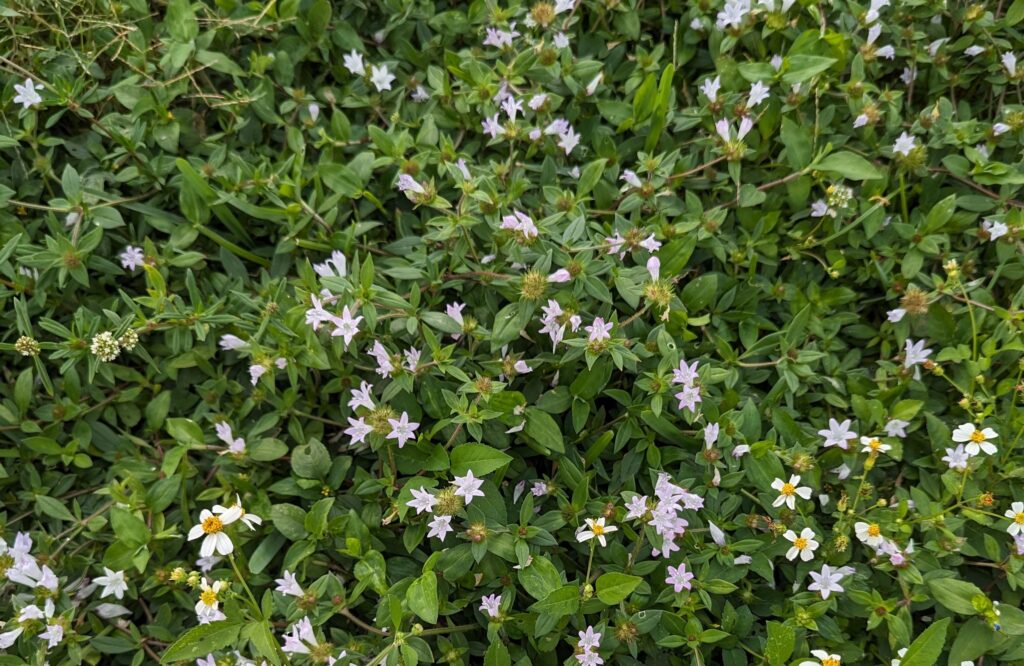
Florida pusley is a broadleaf weed in the Richardia genus, part of the coffee family. Four pusley species grow in Florida, and they look so alike that most people, and plenty of lawn techs, lump them all together as “Florida pusley.”
The three you’re most likely to find in a South Florida lawn:
- Florida pusley (Richardia scabra) — the classic summer weed. Small white flowers, egg- to lance-shaped leaves. Grows as a warm-season annual.
- Brazil pusley (Richardia brasiliensis) — nearly identical to Florida pusley. In South Florida’s warm climate it often hangs on as a perennial.
- Largeflower pusley (Richardia grandiflora) — the one most people now mean by “Florida snow.” Bigger flowers that can be white, pink or lilac, and narrow, lance-shaped leaves. It roots along its stems, forms dense mats, and is the toughest of the three to kill.
You don’t need to know which species you have to treat it, but it helps to know that a perennial pusley patch won’t simply die out at the end of the season.
How to Identify It
- Growth habit: Low and creeping. Stems spread flat along the ground and can reach 30 inches long.
- Stems: Round and covered in stiff, bristly hairs. Run your fingers along one; it feels rough.
- Leaves: Thick, slightly fleshy, hairy, and set opposite each other on the stem.
- Flowers: Clusters of small, star-shaped white flowers with six petals at the stem tips (pink or lavender on largeflower pusley). From a distance, a heavy bloom reads as a white dusting across the lawn.
- Roots: A deep central taproot with fibrous roots branching off. That taproot is why it comes back after you mow it or rip off the top.
It’s most often confused with Virginia buttonweed, which also has white flowers and opposite leaves but grows from creeping rhizomes and prefers wet spots. The hairy stems and the tight flower clusters at the stem tips are your best tells for pusley.
When Does Florida Pusley Pop Up in South Florida?
In South Florida, pusley can sprout in any month. Its seeds germinate best between 68°F and 95°F, and nearly all of them sprout at around 86°F. That covers most of our calendar.
There are two moments when homeowners usually notice it:
- Late spring through summer (roughly May–September): Seedlings flush with the heat and rain, filling in anywhere the grass is thin. They’re small and green at this stage, so they hide in the turf.
- Fall into winter (October–February): This is when the “snow” shows up. Flowering peaks in fall and winter, so patches that quietly established over the summer suddenly turn white. That’s why so many calls about it come in right around now.
Two more things make it persistent here. Florida pusley seeds can germinate almost as soon as they drop, with little rest period. And because Brazil and largeflower pusley act as perennials in our climate, an established patch can keep spreading year after year from the same roots and stem fragments.
One useful quirk: pusley seeds need to sit on or very near the soil surface to germinate. Buried more than about a quarter inch deep, they mostly stay dormant. That’s why bare, exposed soil is such an open door.
Why Pusley Shows Up in Your Lawn
Pusley is a symptom, not the disease. It grows flat to the ground, so it can’t compete with a dense St. Augustine canopy. When you see it, your grass has given up ground somewhere. (We dig into this in more depth in the real reasons weeds take over Florida lawns.)
The usual culprits in South Florida:
- Mowing too low. Scalped St. Augustine thins out and exposes soil to sunlight, exactly what pusley seeds want. Floratam and Palmetto belong at 3.5 to 4 inches; see our recommended mowing heights for Florida turfgrasses.
- Chinch bug and disease damage. Dead patches from summer chinch bugs or fall large patch leave bare spots that pusley fills by the time the lawn is ready to recover.
- Underfeeding through the blackout. Palm Beach County’s nitrogen and phosphorus ban runs June 1 to October 31. Lawns without a blackout-compliant summer plan often come out of October thin and weak.
- Poor watering. Shallow, frequent watering grows shallow roots; overwatering weakens turf and invites disease. Either way, the grass thins.
- Shade and traffic. Under oak canopies and along walking paths, St. Augustine struggles and weeds win.
- Weed-seeded fill. Cheap topsoil or bulk sand used for leveling can carry pusley seed straight into your yard.
How to Prevent Florida Pusley
Prevention comes down to two things: keep the turf too thick for pusley to land, and stop seeds before they sprout.
1. Grow a Dense Lawn
This does more than any product. UF/IFAS notes that healthy, well-managed turf largely prevents pusley on its own.
- Mow tall. Keep standard St. Augustine at 3.5–4 inches and never take more than a third of the blade at once. Our guide to proper mowing practices for Florida covers the details.
- Feed on schedule. The Palm Beach County fertilizer ban ended November 1, so now is the time to help thin turf recover before winter. See when to fertilize your lawn in Florida for the full calendar.
- Water deep, not daily. Fewer, deeper cycles push roots down and keep the canopy thick.
- Fix bare spots fast. Plug or patch with sod before seeds find the gap. Every open patch of soil is a pusley invitation.
- Mulch your beds. In landscape beds, 2–3 inches of pine bark, pine straw or wood chips blocks the light pusley seeds need to germinate.
2. Use a Pre-Emergent on Time
A pre-emergent herbicide forms a barrier at the soil surface that stops seeds as they germinate. It does nothing to pusley that’s already growing.
- Timing: UF/IFAS recommends applying in spring once temperatures hold at 65–70°F for four to five days in a row. In South Florida, that means a first round in early February and a second in late March or early April. Our spring pre-emergent guide for South Florida lays out the schedule. A fall application helps with weeds that germinate as the weather cools.
- Products that work on pusley and are safe on St. Augustine: prodiamine (Barricade), pendimethalin and dithiopyr are the common homeowner options. Professionals also use products like indaziflam (Specticle) and isoxaben (Gallery).
- Water it in. Pre-emergents need irrigation or rainfall to activate. Follow the label for how much and how soon.
- Plan to reapply. No pre-emergent lasts all year. Heavy South Florida rains break the barrier down faster, so a second round is standard.
- Watch new sod. Most pre-emergents shouldn’t go down on freshly laid sod until it has rooted in. Check the label first.
How to Treat Florida Pusley Once It Arrives
Hit it young, pick a product your grass can tolerate, and fill the gap it leaves behind. Mature pusley has a deep taproot, so expect more than one round.
Pull Small Patches by Hand
For a few scattered plants, hand-pulling works. Do it after a rain or irrigation cycle when the soil is soft, and get the whole taproot. Bag plants that are already flowering so you don’t scatter seed. With largeflower pusley, pick up stem pieces too; they can root where they land.
Spot-Treat with a St. Augustine-Safe Herbicide
This is where St. Augustine owners need to be careful. Many broadleaf weed killers that work fine on Bahia, Bermuda or Zoysia will injure St. Augustine. UF/IFAS lists straight 2,4-D as potentially damaging to St. Augustine, and “weed and feed” products are generally discouraged because the herbicide-to-fertilizer ratio rarely fits the job.
Options labeled for pusley that St. Augustine tolerates:
- Atrazine. A go-to for broadleaf weeds in St. Augustine, with both pre- and post-emergent activity. Fall and winter are the best windows, which makes November a good time to start.
- 2,4-D + dicamba + penoxsulam + sulfentrazone premixes. Sold to homeowners as Image Southern Lawn Weed Killer for St. Augustinegrass and to pros as Avenue South. Labeled for Florida pusley.
- Sulfentrazone products. Ortho Nutsedge Killer for Lawns is labeled for Florida pusley. UF/IFAS notes some St. Augustine injury is possible, so follow the label closely.
- Professional-only options. Celsius WG (thiencarbazone + iodosulfuron + dicamba) is labeled for Florida pusley in St. Augustine. Metsulfuron products also work, but they’re applied at such tiny rates that a calibration mistake can kill turf and nearby plants.
For a broader look at what’s safe on your grass, see our roundup of the best weed killers for St. Augustine grass.
Rules That Protect Your Lawn
- Mind the heat. St. Augustine is much more likely to be injured by atrazine, 2,4-D and similar products once temperatures climb above 85–90°F. Spray in the cooler months, or early on a mild day.
- Protect your landscape. Atrazine, dicamba and metsulfuron can injure shrubs, palms and trees whose roots reach into the lawn. Keep applications away from root zones of ornamentals.
- Test first. Try a small, out-of-the-way area before treating the whole lawn, especially on stressed or newly installed turf.
- Read the label. Rates, intervals, grass types and temperature limits are all on it, and it’s the law.
- Be patient. Some products take two to four weeks to show full results. Largeflower pusley is the hardest to control and usually takes repeat applications.
In Landscape Beds
In beds, pusley can be spot-sprayed with a non-selective product like glyphosate, aimed only at the weed (it kills grass and plants too). Contact herbicides, including organic options made from acetic acid or plant oils, burn back the top but struggle with large, flowering plants. Then mulch to keep the next flush from sprouting.
Close the Gap
Killing pusley leaves a hole. If you don’t fill it with grass, the next batch of seed will. Fertilize to push St. Augustine runners into treated areas, or patch larger spots with fresh sod.
A Year of Pusley Control in South Florida
| When | What pusley is doing | What to do |
|---|---|---|
| November–January | Flowering peak (“Florida snow”); setting seed | Spot-treat with atrazine or another St. Augustine-safe product while it’s cool. Resume fertilizing to thicken thin turf. |
| Early February | Seed bank waiting on warm soil | First pre-emergent round, watered in. |
| Late March–April | Germination ramping up | Second pre-emergent round. Patch bare spots. |
| May–September | Seedlings flush with heat and rain | Mow tall, water deep, hand-pull or spot-treat young plants on cooler days. Avoid herbicides above 85–90°F. |
| October | Summer seedlings start blooming | Assess thin spots as the blackout ends; plan fall cleanup and fertilization. |
When to Call a Pro, or Start Over
A few pusley patches are a weekend project. A lawn where the white blanket outnumbers the green is a different problem.
Consider professional help when the pusley keeps coming back after two or three rounds of treatment, when it’s largeflower pusley rooted into mats, or when you’d need professional-grade products you aren’t set up to calibrate.
And if weeds have taken over more than half the lawn, UF/IFAS recommends renovation over treatment. We walk through that decision in re-sodding a weedy lawn in Palm Beach County. Fall and winter are a good time for it, too; here’s why winter works for sod in South Florida. Just fix what thinned the old lawn first, or you’ll repeat the same sod installation mistakes that let the weeds in.
Floridist serves homeowners, HOAs and commercial properties across Palm Beach County with sod installation and science-backed lawn fertilization programs built for South Florida turf.
Florida Pusley FAQs
Is Florida pusley the same as Florida snow? Mostly, yes. “Florida snow” is a nickname for pusley in bloom. UF/IFAS lists it as a common name for both Florida pusley and largeflower pusley; Lee County Extension now uses it mainly for largeflower pusley.
Will mowing get rid of it? No. Pusley grows below the mower blade, and its taproot regrows after you cut the top. Mowing your grass taller does more to stop it than mowing the weed.
Can I use a regular weed killer on St. Augustine? Only if the label lists St. Augustine. Many common broadleaf products built around 2,4-D can damage it, especially in summer heat.
Is it harmful to pets or kids? Pusley itself isn’t considered a hazard. The bigger concern is herbicide use, so follow label re-entry instructions and keep pets off treated areas until the product dries.
Why does it keep coming back in the same spots? Because whatever thinned the grass there, like shade, foot traffic, scalping, pests or a dry zone in your irrigation, hasn’t been fixed. Pusley returns wherever the turf can’t close the canopy.
Sources
- UF/IFAS EDIS: Biology and Management of Pusley (Richardia L.) in Turfgrass and Landscape Planting Beds (ENH1346)
- UF/IFAS Extension Lee County: Controlling “Florida Snow” in St. Augustinegrass Lawns
- UF/IFAS EDIS: Florida Pusley Control in Pastures (SS-AGR-314)
Rather have a pro handle it?
Floridist installs sod and treats lawns across Palm Beach County. Get a free quote in about 30 seconds, or call or text 561-941-GROW.